
UK Sportsbook Markets For Korean KBO Betting
 Available in US
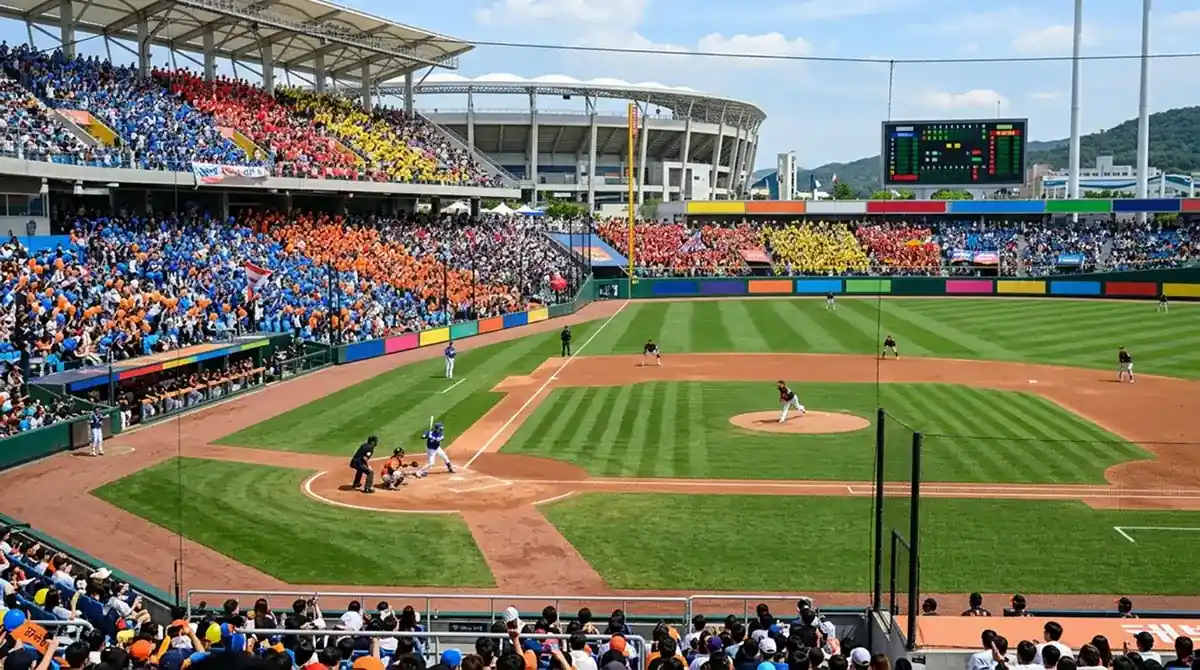
The KBO League sits in a sweet spot for UK bettors: games start in the morning UK time, the market attracts far less sharp attention than MLB, and the lines are noticeably softer. Korean baseball gained a global profile during the early months of 2020, when it was one of the few professional sports still playing. The attention faded, but the betting opportunity did not. If anything, the reduced spotlight makes the odds less efficient — which is exactly what a disciplined bettor wants.
Sports betting now controls over 52% of all online gambling revenue globally, and bookmakers keep adding international baseball coverage to serve that demand. KBO benefits directly: the market that was barely available at UK operators five years ago now appears on most major platforms daily during the Korean season.
Korean KBO Season Structure And Betting Markets
The first thing I had to unlearn about KBO was the assumption that it mirrors MLB. The structures share DNA, but the details are different enough to matter for betting.
KBO consists of 10 teams, all based in South Korea. There are no divisions — every team plays in a single league and competes against all nine opponents during the regular season. Each team plays 144 games, running from late March through October. That is 18 fewer than MLB’s 162, but it still generates a full six months of daily action.
The post-season uses a stepladder format. The third, fourth, and fifth-place teams enter a wild card round. The survivor faces the second-place team in a semi-playoff series (best-of-five), and the winner of that meets the regular-season champion in the Korean Series (best-of-seven). The top team earns the considerable advantage of bypassing two rounds and entering the final with home-field advantage — which makes the regular-season title race a genuine betting market in its own right.
Like NPB, KBO games can end in draws after extra innings. The current rule allows 12 innings before a tie is declared. Settlement rules vary between UK bookmakers — some void moneylines on draws, others offer three-way markets. Verify before you bet.
Scoring Patterns, Pitching Depth, and What Shapes KBO Lines
KBO is a higher-scoring league than either NPB or MLB. Average run production is typically half a run to a full run higher per game than MLB, and significantly above NPB. The reasons are structural: the pitching depth across 10 teams is shallower than in MLB’s 30-team talent pool, the ball is lively, and several KBO stadiums are compact with hitter-friendly dimensions.
For totals bettors, this run environment means KBO totals are set higher than you might expect if you are calibrating from MLB norms. A KBO total of 9.5 is routine. Games finishing 7-6 or 8-5 are not unusual. If your instinct from MLB says “that total looks too high,” recalibrate — KBO’s offensive environment justifies it.
Pitching depth is the key analytical variable. KBO starting rotations are typically five-man, but the drop-off from the ace to the fifth starter is steeper than in MLB. When a team’s top starter pitches, the game profile is closer to an MLB contest. When the fifth starter takes the mound, the game can turn into a high-scoring affair that barely resembles professional baseball. I focus my KBO betting on matchups where I have a clear view on the pitching mismatch — ace vs fifth starter is the archetype I target most often.
Bullpen quality also varies more dramatically. Some KBO teams have reliable closers and setup men; others are essentially rolling the dice from the seventh inning onward. This variance creates opportunities in both totals (late-inning scoring spikes) and live betting (bullpen entry as a trigger for odds movement). Andrew Rhodes, the UK Gambling Commission’s CEO, has emphasised that research and data are essential to understanding risk profiles in gambling — that principle applies equally to the analytical work bettors need to do before entering less familiar markets like KBO.
UK Bookmaker Coverage and Market Depth for KBO
KBO coverage at UKGC-licensed bookmakers has improved but remains thinner than MLB and even NPB at some operators. The typical offering is moneylines and totals for most regular-season games. Run lines, player props, and in-play markets are available at the larger operators but not guaranteed across the board.
I use three indicators to assess an operator’s KBO market quality: daily game coverage (does the bookmaker list all five daily KBO fixtures, or only selected ones?), market variety (moneyline plus totals is the minimum — run lines and first five innings lines signal deeper commitment), and odds competitiveness (compare the moneyline across three or four operators to see which one is consistently offering the longest price).
The thin liquidity in KBO markets works in the informed bettor’s favour. Bookmakers rely on automated line-setting tools that may not incorporate KBO-specific nuances — pitcher rest patterns, park-specific wind conditions, or the current form of a team’s bullpen. If you are doing that manual research, you are competing against an algorithm, not against a roomful of sharp analysts. That is the definition of a soft line.
One caveat: the same thin liquidity means bookmakers may limit your stake or restrict your account more quickly if you are consistently profitable on KBO. I keep my KBO unit sizes modest — roughly half my MLB unit — both for bankroll management and to avoid triggering account restrictions.
For UK bettors interested in broadening their baseball betting portfolio beyond NPB, which covers the Japanese league in similar detail, KBO adds a second morning-schedule option and further diversifies your exposure across different league dynamics.
Where KBO Fits in a UK Bettor’s Daily Schedule
The practical appeal of KBO is identical to NPB but shifted slightly: most KBO games start at 18:30 Korea Standard Time, which is 10:30 BST (09:30 GMT in winter). Some weekend or holiday fixtures start earlier at 14:00 or 17:00 KST. The schedule aligns almost perfectly with NPB, so on most days you can research both leagues in a single morning session.
My daily rhythm when both leagues are in season: wake up, check overnight NPB/KBO results, review the day’s NPB and KBO lineups (usually confirmed by 08:00-09:00 UK time), place bets by 09:30-10:00, and then shift to MLB preparation for the afternoon. This cadence gives me action across three baseball leagues within a single day — and three independent data sets to refine my analytical approach.
The morning slot also means KBO results are settled before MLB lines open. If a KBO trend I am tracking — say, a team’s bullpen collapsing over a five-game stretch — has implications for how I approach similar situations in MLB, I can incorporate that thinking in real time. Cross-league pattern recognition is an underrated skill, and the schedule makes it practical.
Which UK bookmakers consistently offer KBO odds?
The larger UKGC-licensed operators with broad international sports coverage are the most reliable for daily KBO markets. Availability fluctuates — some operators list KBO only during peak interest periods. The best approach is to check three or four major operators during the first week of the KBO season to identify which ones provide consistent daily coverage with competitive odds.
Is there enough public KBO data to build a betting model?
Basic KBO team statistics — wins, losses, runs scored, runs allowed, home/away splits — are available on English-language sports data sites. Individual player stats are harder to find in English but accessible through Korean baseball databases with translation tools. The data is sufficient for a team-level model focused on moneylines and totals, though it does not approach the granularity available for MLB. Most profitable KBO bettors rely on a simpler model supplemented by manual research on pitching matchups and recent form.
Written by the editors at Betting on Baseball Games.