UFDS Protection And Sportradar MLB Integrity Monitoring
 Available in US
Every time you place a bet on an MLB game at a UKGC-licensed bookmaker, the odds you see and the settlement you receive depend on a data pipeline that runs through one company. Sportradar holds an exclusive 8-year partnership with Major League Baseball, covering official data distribution, real-time feeds, and — most critically for market trust — integrity monitoring through its Universal Fraud Detection System. MLB invested so heavily in this relationship that it acquired an equity stake in Sportradar, binding the league’s commercial interests directly to the quality of the monitoring infrastructure.
Understanding how this system works is not academic. If you bet on baseball, Sportradar’s technology is the invisible layer between you and a clean market. When it works, you never notice it. When it catches something — as it did during the Guardians cases — the entire industry benefits.
Global Betting Scans Using Universal Fraud Detection
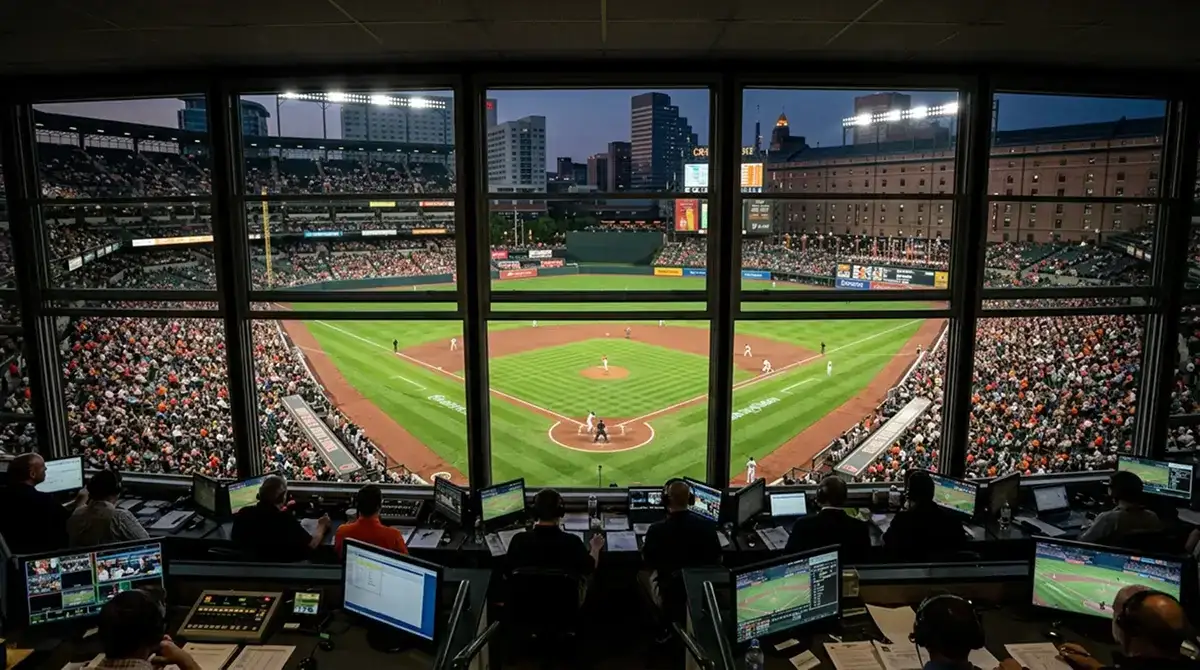
I think of the UFDS as the CCTV network of sports betting — always watching, always comparing what it sees against what it expects. The system monitors betting activity across Sportradar’s global network of 800 bookmaker clients in real time. That is not a sample; it is nearly the entire regulated market. When a bet is placed on an MLB game anywhere in the world — London, Las Vegas, Melbourne — the UFDS sees the aggregate pattern.
The system works by establishing expected betting patterns for every game based on historical data, team quality, pitching matchups, and market norms. It then monitors live betting flows for deviations. If a specific market — say, the first-inning total on a particular game — suddenly attracts an unusual volume of bets at unusual stake sizes, the UFDS flags it for human review. The flag does not mean something is wrong; it means the pattern is anomalous enough to warrant investigation.
What makes UFDS sophisticated is the layering. It does not just track volume; it tracks velocity (how quickly bets are placed), origin (where the money is coming from geographically), and correlation (whether the same anomaly appears across multiple bookmakers simultaneously). A surge at a single operator might be one whale placing a large bet. The same surge at fifteen operators simultaneously, on a niche market, is a different signal entirely.
The system also monitors line movements. If a line moves sharply without a corresponding public information trigger — no injury announcement, no weather change, no lineup alteration — the movement itself becomes an alert. Something is driving the money, and the UFDS wants to know what.
Sportradar publishes integrity reports periodically, disclosing the number of alerts generated and the sports and regions involved. Baseball generates fewer integrity alerts than football (soccer) globally, which reflects both the smaller betting volume on MLB compared to the Premier League and the robust monitoring partnership MLB has in place.
The MLB-Sportradar Partnership: Scope, Data Rights, and Equity Stake
The partnership extends far beyond integrity monitoring. Sportradar is MLB’s exclusive provider of official real-time data to the global betting industry. Every pitch, every play, every substitution flows through Sportradar’s systems before reaching the bookmakers who set your odds. Carsten Koerl, Sportradar’s CEO, has described the journey from roughly $300 million in US sports betting gross gaming revenue at the time of legalisation in 2018 to nearly $14 billion by 2024 — and Sportradar’s data infrastructure underpins a significant portion of that growth.
The 8-year term, running through 2032, gives both parties stability. MLB gets a long-term integrity partner whose financial incentives are aligned with clean markets. Sportradar gets exclusive access to the data that drives betting product creation for one of the world’s most heavily wagered sports. The equity stake MLB acquired in Sportradar deepens the alignment — MLB is literally invested in Sportradar’s success, and Sportradar’s reputation depends on maintaining the integrity of MLB data.
Kenny Gersh, MLB’s EVP for gaming and new business ventures, has positioned the partnership around the idea that a high-quality, reliable, and fast official data feed is the building block for creating engaging products for fans. For bettors, “engaging products” translates to accurate odds, reliable settlement, and markets that reflect what is actually happening on the field rather than what someone is trying to manipulate.
The exclusivity clause is significant for UK bettors. Because Sportradar is the sole authorised data provider, all UKGC-licensed bookmakers offering MLB markets are working from the same official feed. This standardisation means you are unlikely to encounter settlement discrepancies between operators caused by different data sources — a problem that occasionally arises in sports where multiple competing data providers exist.
Why Integrity Infrastructure Matters to UK Bettors
You might wonder why a UK punter placing a moneyline bet should care about an American company’s fraud detection technology. The answer is direct: the price you are offered reflects the bookmaker’s confidence that the game is clean. If that confidence erodes — if integrity scandals become frequent and monitoring is perceived as inadequate — bookmakers respond by widening margins to compensate for the added risk. Wider margins mean worse odds for you.
Rob Manfred framed monitoring as the bedrock of MLB’s relationship with sportsbooks. That is not just corporate language — it is a description of how trust translates into pricing. When bookmakers trust that the data feed is clean and the monitoring system catches anomalies, they can offer tighter margins. When trust is shaken, margins expand and limits shrink. The Guardians scandal tested this trust, and the fact that UFDS detected the suspicious patterns before they became public actually strengthened confidence in the system rather than undermining it.
For bettors who track closing line value and line movement as part of their analytical approach, the integrity infrastructure provides a secondary benefit: it ensures that line movements are driven by legitimate information and money flow rather than by manipulation. If lines are moving because sharp bettors have identified value, that is useful market signal. If lines are moving because someone with inside information is exploiting a micro-market, that is noise that distorts your analysis. UFDS works to filter out the latter.
The integrity infrastructure also supports the regulatory environment. The UK Gambling Commission requires that licensed operators use reliable data sources and maintain systems to detect suspicious activity. Sportradar’s partnership with MLB helps UK operators meet those requirements, which in turn supports the licensing framework that protects your funds and your data. The chain runs from Sportradar’s monitoring to MLB’s data, to the bookmaker’s platform, to the UKGC’s regulatory oversight, and finally to you — the bettor whose wager depends on every link in that chain holding firm.
Integrity is not a feature you actively use. It is the foundation you never think about unless it fails. Sportradar’s UFDS, combined with MLB’s direct investment in the monitoring relationship, represents the most comprehensive integrity infrastructure in baseball betting history. As a UK bettor, you benefit from it every time you place a bet — even if you never see it working.
Can individual bettors see Sportradar alert data?
No. UFDS alert data is shared with leagues, regulatory bodies, and law enforcement — not with the public or individual bettors. Sportradar does publish periodic integrity reports with aggregate statistics on the number and type of alerts generated, but these do not identify specific games or markets. The system is designed to protect the market at an institutional level, not to provide individual bettors with real-time integrity signals.
Does Sportradar monitor UK bookmaker activity on MLB markets?
Yes. Sportradar’s UFDS monitors betting activity across its global network of approximately 800 bookmaker clients, which includes major UKGC-licensed operators. If suspicious betting patterns on MLB markets originate from UK-based operators, the UFDS will flag them in the same way it monitors activity from any other jurisdiction. The monitoring is global in scope, not limited to US-based betting.
Prepared by the Betting on Baseball Games editorial staff.